

How did an area used to for the manufacture hazardous chemical weapons turn into be home for more than 330 species of wildlife & a place to visit.
This article covers the location of the Rocky Mountain Arsenal National Wildlife Refuge, the Visitors Centre, and the car / hiking trail.
Location
Just outside Denver and Commerce City, Colorado, the Rocky Mountain Arsenal National Wildlife Refuge is a 15,988-acre (24.981 square miles) National Wildlife Refuge making it one of the largest urban refuges in the United States.

It has a mixed history of being a military arsenal manufacturing hazardous chemical weapons and fuel for the Apollo space missions &, now, is a National Wildlife Refuge home to more than 330 species of wildlife & a place open to the public to visit
Information and orientation at the Visitors Center
The Visitors Center provides a great opportunity to orientate and prepare for your visit especially sign-posting the key features of the Wildlife Refuge & the hiking and driving trails in a handy booklet. Inside there is a small exhibition area giving insight into the wildlife homed on the Refuge including bald eagles, bison, black-footed ferrets, deer, coyotes and prairie dogs with interactive exhibits for children and adults alike.

It covers the history of the use of the area for the production of hazardous chemical weapons from the 1940s to the 1980s with clear displays of the contaminated soil present on the site and the protection needed for the hazardous presented by the chemical used.
For those interested in the legislation, the site was listed on the National Priorities List, a list of hazardous waste sites in the United States eligible for long-term remedial clean-up action financed under the federal Superfund program under the Comprehensive Environmental Response, Compensation, and Liability Act of 1980 (CERCLA) and managed by the Environmental Protection Agency.
Later, US Congress enacted the Rocky Mountain Arsenal National Wildlife Refuge Act on 25 September 1992 with the legislation signed into law by President George H. W. Bush on 9 October of the same year. The law stipulated that a majority of the RMA site would become a national wildlife refuge under the jurisdiction of the United States Fish and Wildlife Service once the environmental restoration is completed, which continues to have oversight over the Refuge.
Taking to the Trails
That handy booklet that is available at the Visitors Centre mentioned earlier comes with a clear location map outlining the 20 miles of trails that are open for motor vehicles, bikes and hiking.
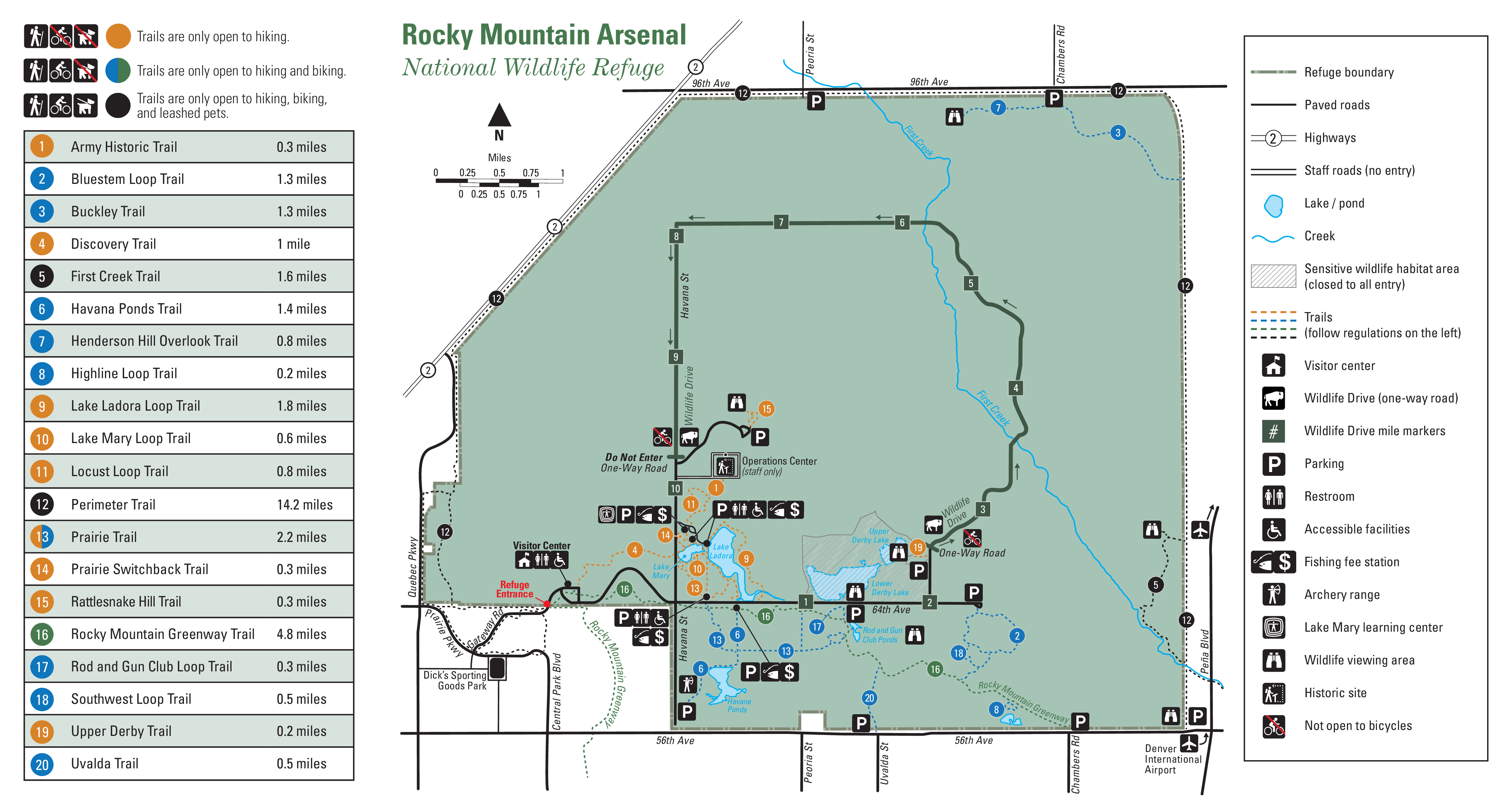
To get the most from our visit, I chose the 11-mile self-guided Wildlife Drive using my car, which takes approximately 1 hour and the accompanying podcast freely available from Apple Podcasts, Spotify and other podcast providers.

My visit was in mid-January and so there was a few inches of snow on the trail road but nothing that a regular car couldn’t drive on, so no need for a special SUV or 4×4 vehicle.
Depending on the climate and seasonal demands, the wildlife may be more or less visible from the Trail Road. The minus 10 degrees Celsius temperatures meant that many of the animals and birds making the most of shelter and trying to keep warm.
Early on in our trail drive, we came across a herd of deer that were readily visible from the road and easily photographed.

At various points in our trail tour, you can see evidence of the past use of the Refuge as a chemical weapons site with this observation buildings, partial buildings & cleanup mounds and ponds.

Other parts of the trail drive were open spaces with no opportunity to see wildlife but was nonetheless a great time to enjoy a slow drive overlooking the open refuge area with few other vehicles to the front or behind me. A time to truly take in the splendour of the open prairie land
Two wildlife animals that I wanted to look out for were the Prairie Dogs, which as we learnt at the Visitors Center are burrowing ground squirrels & the American Bison, not to be confused with their distant European and African relatives, the buffalo.
On the final stretch of the Trail Road, I, first, came across the Prairie Dogs popping up from their warm below-ground burrows to see what was happening with an opportunity to take some video of these fascinating animals that are the true natives of the American Prairie. The Wildlife Refuge is capable of supporting thousands, even tens of thousands of Prairie Dogs.

As I come from a country that does have Prairie Dogs or, even, prairies. It was fascinating to observe them and their reaction to me observing them and the other vehicles, stopping to observe them or passing them by.
A little further on from the cute Prairie Dogs, we came across a herd of Bison. The Visitor Center had warned that I should keep about a suitable distance from the herd. This was not a problem during my visit but in other situations or warmer months, the herd may venture closer to the road with care advised to any road user.

Again, it was a privilege to have the opportunity to view the Bison in their natural habitat not only as they are not native in the United Kingdom but as they were hunted close to extinction during the 19th and 20th centuries before rebounding due to active conservation measures.
After over 20 minutes observing these magnificent animals, it was time to move on and return to the Visitors Center for some final souvenirs of books on the Wildlife Refuge and its inhabitants.
I left with a sense of the majesty of the prairie plains and its inhabitants especially the bison that roamed in North America before settlers moved westward and took advantage of them for food and clothing.
For me, the fact that the site had been previously been contaminated by man with hazardous chemicals from the manufacture of munitions and other chemicals gave a further sense of hope that mankind can turn back the damage that has been done to our natural environment and redeem our negative environmental impacts to leave the world, a better place. Not perfect but getting there.
If this article has helped to advance your understanding of the history of the Wildlife Refuge, its clean-up and its inhabitants, please leave a comment in the box below, if this video has help you.
If you enjoyed this article, you should check out our YouTube Channel – EMSmastery, where you can watch our videos, such as our video accompanying this article on How a hazardous site became the nation’s largest Wildlife Refuge! and subscribe in our YouTube channel for new videos released each week.
#rockymountains #wildliferefuge #emsmastery